

Ranking at the top of ChatGPT is a strategic process that enables brands to increase their visibility in AI-powered search engines. This process is called Generative Engine Optimization (GEO) and operates on different dynamics than traditional search engine optimization. Large Language Model (LLM) algorithms must perceive your brand as a semantic entity while crawling data across the web and reference it as a trustworthy source. Establishing authority in these systems, which operate on a Retrieval-Augmented Generation (RAG) architecture, is shaping the future of digital marketing.
Discover our GEO strategies to increase your brand's visibility in AI-powered search engines (ChatGPT, Gemini, Perplexity, etc.). You can reach us immediately at 0850 333 80 91 or visit our Generative Engine Optimization page.
What Is ChatGPT Optimization (GEO) and How Does It Work?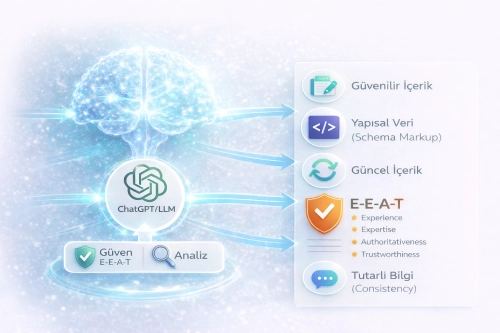
ChatGPT Optimization (GEO) is the structuring of content so that it can be understood by AI systems, evaluated within context, and used directly in generating responses; whereas the goal in SEO is ranking, the goal in GEO is to be included in the answer itself. For this reason, content is prepared not with a keyword-focused approach, but in a structure with strong semantic coherence, clarity, and trust signals, making it easier for LLMs to select and reference.
The Rise of AI Search Engines and the Concept of GEO
Generative Engine Optimization (GEO) is the optimization of content so that it is read and synthesized by AI language models and referenced in the responses given to users. While traditional search engines list pages in a ranked order, AI engines blend information to produce a single direct answer. These systems crawl data across the web, analyze credibility signals, and combine sources to present the most accurate context to the user.
With the integration of AI search engines into daily life, the habits through which users access information have undergone a fundamental shift. Users are now gravitating toward AI assistants that offer directly synthesized and clear answers, rather than browsing through long lists of links. This transformation makes it necessary for brands to build not only a keyword-focused structure in their digital marketing strategies, but also one oriented around context and authority.
According to industry data, a large portion of users now expect to receive instant answers to their complex questions. For example, when a user searches for "best cloud storage solutions," ChatGPT does not simply present a list; it blends the features of brands, user reviews, and industry references to generate a recommendation text. This requires brands to structure their content not only for search engine bots, but also for AI algorithms that synthesize information.
By adapting to this new generation of search behavior, brands gain the advantage of appearing directly in front of their target audience as a trusted authority. Having content that is understandable and synthesizable by AI forms the foundation of organic visibility. For this reason, GEO strategies have become an indispensable investment for brands seeking to sustain their presence in the digital ecosystem.
How Do LLMs (Large Language Models) Evaluate Brands?
Large Language Models (LLMs) are AI algorithms trained on massive datasets and capable of understanding natural language. When evaluating a brand, these models do not look only at the text on its website; they also cross-query brand mentions across the digital ecosystem, reviews on evaluation platforms, and the brand's presence in industry publications. The algorithms analyze all signals across the web as a whole to measure the brand's credibility.
When evaluating content, LLMs focus on semantic coherence and context rather than exact word matching. For content to be considered high quality, the topic must be explored in depth together with all its subtopics and related concepts. Superficial texts stuffed only with keywords are deemed worthless by AI and excluded from the reference pool.
According to analyses, even if an e-commerce infrastructure provider produces excellent content on its own site, if it is not mentioned on Reddit, Quora, or industry forums, LLMs may not find the brand sufficiently authoritative and may not reference it in their responses. In accordance with its impartiality principle, AI places greater weight on user experiences and expert opinions on independent platforms than on a brand's own statements.
If you want to increase your brand's digital visibility, permanently grow organic traffic, and gain greater presence in AI-powered search systems (GEO/LLM), you are in the right place. Magna Dijital Marketing Agency offers end-to-end SEO services from technical analysis to content strategy. For detailed information, you can reach us immediately at 0850 333 80 91 or visit our SEO Services page.
The Foundations of Establishing Authority in the ChatGPT Algorithm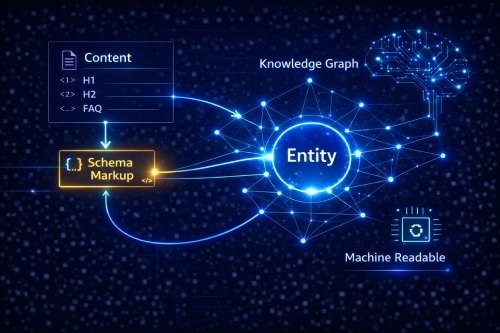
The path to achieving lasting visibility in AI-powered search engines runs through building unshakeable authority in the digital ecosystem and presenting content within a framework of semantic coherence. The ChatGPT Search Era Has Begun
Semantic Entity Optimization
Semantic entity optimization is the process of having your brand, products, or services recognized by AI as meaningfully related concepts (entities). Rather than reading words one by one, AI maps the relationships between concepts and builds a vast Knowledge Graph.
Having semantically rich content depends on presenting synonyms, subheadings, and industry terms as a coherent whole.
For a brand to occupy a strong node in this knowledge graph, its digital assets must be in a machine-parsable structure.
Organizing content with a logical hierarchy, keeping headings clear, and supporting information with structured data (schema markup) enables AI to correctly interpret the content. This technical infrastructure is the cornerstone of semantic optimization.
Content with semantic depth guarantees that your brand becomes the primary reference point in AI's responses to complex questions. Contextually enriched texts that provide clear answers to users' long-tail and detailed queries are among the sources most preferred by ChatGPT during its synthesis process. This strategy positions your brand as the knowledge leader of your industry.
The RAG (Retrieval-Augmented Generation) Effect and Data Feeding
RAG (Retrieval-Augmented Generation) is an innovative architecture that enables AI models to generate responses by pulling real-time information from the internet in addition to their own static training data. When systems like ChatGPT encounter a current query, they perform an instant scan via Bing or other search APIs and synthesize the freshest and most authoritative data they find to present to the user. This dynamic structure makes the currency of content more important than ever.
In this process, it is not enough for content to merely exist; it must also be easily accessible and rapidly processable by AI bots. Having your site be technically crawlable, keeping your robots.txt file open to AI bots (such as GPTBot), and optimizing server response times are of critical importance for the RAG architecture to seamlessly pull data from your site.
According to industry data, when a financial institution that publishes a current 2026 market research report presents its data with clear headings and schema markup, ChatGPT directly cites that institution's latest report in response to real-time financial analysis queries. Original data, statistics, and industry reports are the types of content that AI values and references most.
Keeping your content continuously up to date and ensuring technical accessibility allows your brand to outpace competitors in real-time AI searches. Companies that adapt to RAG dynamics gain lasting visibility in the AI ecosystem not only through their past achievements, but also through their fast and structured responses to current developments.
Make your business processes smarter, more efficient, and more predictable with AI-powered marketing models. For details, you can reach us immediately at 0850 333 80 91 or visit our Artificial Intelligence Consultancy page.
Steps to Take to Rank at the Top of ChatGPT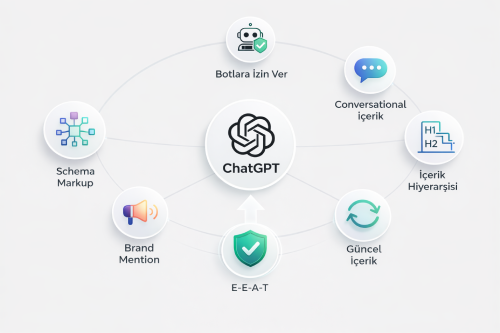
In this new era dominated by AI-powered search engines, you should quickly implement the following strategic steps to protect and increase your brand's digital visibility:
- Allow AI Bots: Update your site's robots.txt file to explicitly permit ChatGPT (GPTBot) and Bing bots to crawl your content.
- Produce Conversational Content: Create content formats that provide direct and clear answers to long-tail questions users ask in everyday language.
- Use Structured Data (Schema Markup): Integrate Article, FAQ, How-To, and Product schemas into your site to help AI interpret your data with ease.
- Increase Brand Mentions: Don't think solely in terms of backlinks; conduct digital PR efforts to ensure your brand's name appears on Quora, Reddit, industry forums, and trusted news sites.
- Clarify Content Hierarchy: Use H1, H2, and H3 headings in a logical sequence and provide the answer to the question posed at the beginning of each section directly.
- Keep Information Continuously Updated: AI models favor fresh data. Regularly refresh your older content with new statistics, current dates, and the latest industry developments.
- Comply with E-E-A-T Criteria: Strengthen credibility signals by including author biographies, proof of expertise, and original research in your content.
Differences Between Traditional SEO and ChatGPT Optimization (GEO)
The fundamental differences between classic search engine optimization and AI search engine optimization are reshaping the digital marketing approaches of brands.
|
Comparison Criterion |
Traditional SEO (Google/Bing) |
ChatGPT Optimization (GEO) |
|
Ranking Logic |
Presents pages in a list format (SERP). |
Synthesizes information to produce a single direct answer. |
|
Keyword Focus |
Short and exact-match keywords are important. |
Long-tail, conversational, and semantic context is critical. |
|
Authority Signals |
Backlink profile and domain authority are the basis. |
Brand mentions, reviews, and digital PR come to the fore. |
|
User Intent |
The user completes their research by browsing different sites. |
The user completes their research directly within the chat interface. |
|
Content Structure |
Long and detailed articles provide a ranking advantage. |
Clear, structured, directly answer-giving, and crawlable content is preferred. |
The future of digital marketing is being shaped by artificial intelligence. Magna Dijital Marketing Agency accelerates brands' digital transformation with data-driven approaches and LLM (Large Language Model)-based strategies. Contact us to carry your brand into the future with GEO, machine learning, and AI-powered marketing applications. You can reach us immediately at 0850 333 80 91 or visit our Artificial Intelligence Technology page for detailed information.
Frequently Asked Questions
How does ChatGPT select sources in search results?
When responding to user queries, ChatGPT uses the Bing search infrastructure and its own training data. When selecting sources, it pays attention to the relevance and currency of the content, the brand's credibility in the digital ecosystem, and its semantic coherence.
How long does GEO (Generative Engine Optimization) take to show results?
GEO work is, similar to traditional SEO, a medium- to long-term process. AI models scanning, indexing new data, and positioning your brand as an authority generally begin to show noticeable results within 3 to 6 months.
How do I get my site crawled by ChatGPT?
For your site to be crawled by ChatGPT, you need to permit AI crawlers such as GPTBot and Bingbot in your robots.txt file. Additionally, providing a clean XML sitemap and reducing JavaScript dependency improves crawling efficiency.
Why are brand mentions more important than backlinks?
AI language models do not rely solely on clickable links (backlinks) to measure a brand's credibility. Having your brand mentioned in a positive context across different platforms, forums, and news sites creates a strong authority signal for LLMs.
Which content types perform best for ChatGPT SEO?
Frequently asked questions (FAQ), step-by-step guides, detailed product comparisons, and informational articles containing clear definitions are the content types that deliver the highest performance in ChatGPT optimization.
Is structured data (Schema Markup) mandatory for GEO?
While not mandatory, it is extremely critical. Schema Markup explains to AI in machine language what your content is about. This allows ChatGPT to synthesize your data far more quickly and accurately and incorporate it into its responses.
Should I abandon my traditional SEO work and focus solely on GEO?
No, traditional SEO and GEO are complementary strategies. Websites that hold high rankings on Google or Bing and have a strong SEO foundation tend to be considered more trustworthy by AI models and to be referenced more frequently.
How does RAG (Retrieval-Augmented Generation) architecture affect SEO?
RAG architecture enables AI to perform real-time web crawling and deliver the most current information. This makes it necessary from an SEO perspective to keep your content continuously updated and to provide a technically fast-crawlable infrastructure.
.webp)