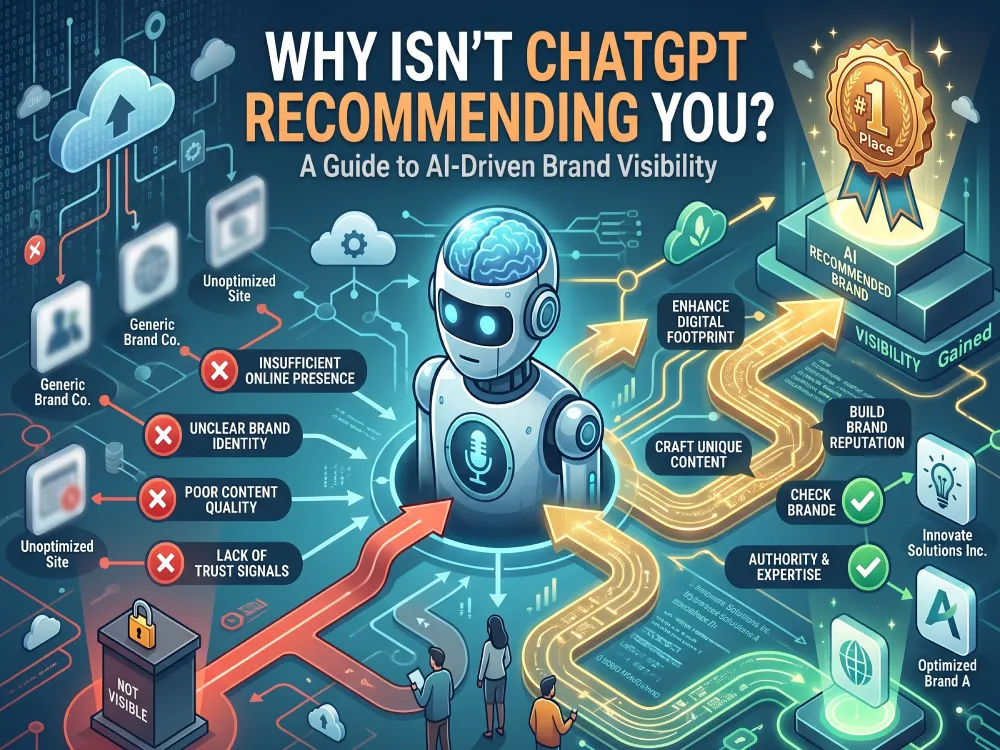

GEO strategy is the process of making the digital content of brands compatible with the operational logic of AI-supported search engines such as ChatGPT and Gemini. Based on GEO principles, this strategy ensures that content is correctly understood and referenced by LLMs. The setup phase includes steps for improving technical infrastructure, ensuring semantic integrity, and creating an entity-oriented content architecture. In this guide, we discuss the core components of GEO strategy, implementation steps, and the points brands should consider to become more visible in AI searches, step by step.
Discover our GEO strategies to increase your brand's visibility in AI-supported search engines (ChatGPT, Gemini, Perplexity, etc.). You can reach us immediately at 0850 333 80 91 or visit our Generative Engine Optimization page.
What is GEO Strategy and Why is it Important?
GEO is a next-generation optimization approach that aims not only for brands to achieve rankings in search engines but also to be understood and referenced by AI-supported systems. As user behaviors rapidly shift toward AI-supported searches, visibility is no longer limited to appearing on the SERP. This transformation makes it mandatory for brands to reconfigure their content in accordance with the information processing and synthesis logic of artificial intelligence. GEO strategy ensures that brands become visible, reliable, and preferred sources in this new ecosystem.
The Concept of Generative Engine Optimization (GEO)
Generative Engine Optimization (GEO) is a comprehensive optimization process that enables digital assets to be discovered, understood, and referenced by AI-supported search engines and answer engines. According to sector data, users' information-seeking habits are rapidly shifting from traditional search engines to AI assistants. This change necessitates that brands not only rank on search engine results pages (SERPs) but also take part as a reliable source within the responses generated by AI. GEO is a strategic approach designed to meet this next-generation visibility need.
At the core of this concept lies a fundamental paradigm shift in the operational logic of search engines. While traditional systems list links to lead users to information, generative AI engines synthesize information directly to present the final answer to the user. This situation completely changes the traffic acquisition models of websites, increasing the rate of "zero-click" searches. GEO strategy aims to prevent the brand from becoming invisible in this zero-click ecosystem, highlighting the brand name and expertise in AI Overviews.
Information Synthesis Logic of LLMs
Large Language Models (LLMs) are advanced AI systems that work by reading and understanding massive amounts of data on the internet and mapping the semantic relationships between this data. While traditional search engine crawlers scan web pages solely for indexing purposes, LLM-based bots scan to learn information and synthesize it to generate responses to future questions. These systems focus on contextual usage rather than the dictionary definitions of words, combining all dimensions of a subject on a conceptual network.
The information synthesis process begins when a user asks a question and continues with the AI scanning sources that can provide the most accurate answer in seconds. Instead of relying on a single source, LLMs cross-check data received from different websites, academic articles, and reliable platforms. Information that is consistent, supported by statistics, and carries expertise signals is filtered and turned into a single, fluent text. At this stage, contradictory or structurally weak content is considered unreliable by the algorithm and excluded from the synthesis process.
For LLMs to successfully perform this complex synthesis, content must comply with machine readability standards. Instead of long and complex paragraphs, AI processes texts much more easily if they get straight to the point, provide clear definitions, and contain semantic triples (subject-predicate-object). For example, presenting a product's features through a structured table or a bulleted list instead of plain text exponentially increases the likelihood of the LLM extracting this data and integrating it into its generated response.
This synthesis logic requires brands to center the question "How does AI read and use this information?" when creating their content strategies. Since LLMs take the source's reliability into account when presenting information, technically correct content alone is not enough; this content must also be supported by an authoritative identity.
The future of digital marketing is being shaped by artificial intelligence. Magna Dijital Marketing Agency accelerates the digital transformation of brands with data-oriented approaches and LLM (Large Language Model) based strategies. Contact us to carry your brand into the future with GEO, machine learning, and AI-supported marketing applications. You can reach us immediately at 0850 333 80 91 or visit our AI & Technology page for detailed information.
Step-by-Step Generative Engine Optimization Strategy Setup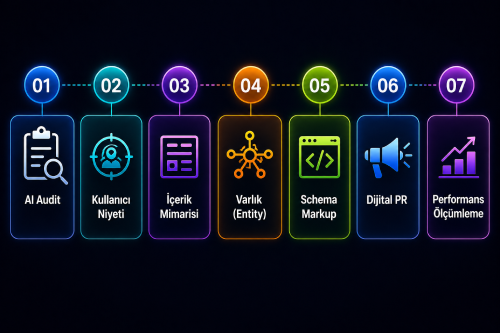
- Conduct a Current Status Analysis (AI Audit): Before establishing your strategy, test your brand's current visibility in AI engines. Map out how AI perceives you and which competitors it recommends by asking tools like ChatGPT, Gemini, and Perplexity about your brand, products, and core issues in your sector.
- Redefine User Intent: Identify long, complex, and contextual questions (prompts) that users might ask AI instead of traditional short keywords. Update your content plan to directly answer these long-tail and multi-layered questions.
- Adapt Content Architecture for AI: Give your existing and new content a modular structure that AI can easily crawl and synthesize. Provide clear definitions summarizing the topic immediately under each subheading (H2, H3); support information with tables, bulleted lists, and FAQ (Frequently Asked Questions) sections.
- Build Entity Authority: Use all concepts, brands, and terms related to your sector within a semantic integrity in your content, not just keywords. Prefer clear and direct sentence structures (subject-predicate-object) so that AI can resolve the relationships between these concepts.
- Perfect Technical Infrastructure and Schema Markup: Integrate structured data (Schema) tags such as FAQ, Article, HowTo, and Organization into your site so that search engine bots can fully understand the context of your content. Elevate your site speed and mobile compatibility to the highest level.
- Conduct External Validation and Digital PR: AI models look at citations across the internet to measure your brand's reliability. Strengthen your external authority by ensuring your brand name is mentioned (brand mentions) on sectoral news sites, reliable blogs, and review platforms.
- Measure Performance and Improve the Strategy: Move beyond traditional click metrics and regularly track how often you are cited in AI Overviews, the increase in your brand name's search volume, and the referral traffic coming from AI platforms to update your strategy.
Make your business processes smarter, more efficient, and more predictable with AI-supported marketing models. For details, contact us now at 0850 333 80 91 or visit our AI Consultancy page.
Success Factors in GEO-Compatible Content Production
GEO-compatible content production requires an approach that goes beyond keyword-oriented writing and centers on how AI systems perceive and process information. In this process, configuring content as entity-oriented, carrying semantic integrity, and supporting it with reliable source signals plays a critical role. AI models prefer not only accurate information but also clear, structured, and verifiable content. Therefore, a successful GEO strategy must be built on a strong foundation both technically and contextually.
Entity-Based Optimization 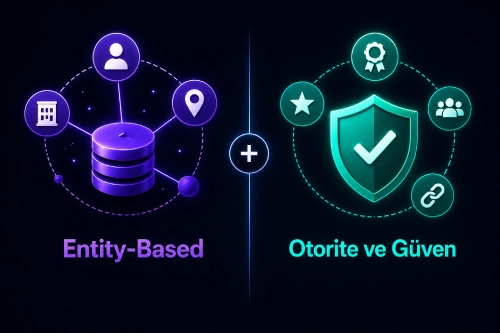
Entity-Based SEO is a strategic approach that shifts the focus in search engine optimization away from individual keywords to "entities" (person, organization, place, concept, product) that carry meaning. In the context of GEO strategy, entity-based optimization is of vital importance as it directly aligns with how AI models understand the world. LLMs perceive texts not as sequences of words, but as a massive network of information formed by interrelated entities. Therefore, for content to be correctly interpreted by AI, these entities must be clearly defined.
When configuring entity-oriented content, it is essential that all side concepts and related terms surrounding the target topic are naturally integrated into the text. For example, if content is being produced around the main entity "digital marketing," sub-entities such as "SEO," "content marketing," "conversion rate," and "target audience" must also be used within a contextual integrity. This approach sends strong signals to AI engines about how comprehensive and in-depth the content is, ensuring the page is accepted as an authority on that topic.
One of the most critical technical steps of this optimization process is the correct use of semantic triples. Sentences in which the relationship between subject, predicate, and object is clearly established make it easier for AI to record the information in its database as a "fact." Using direct expressions like "Brand X offers Service Y" or "Software Z performs data analysis" instead of complex, indirect, or literary narratives increases the likelihood of LLMs extracting this information and using it as a reference in their own generated summaries.
Building Authority and Trust Signals
Since AI-supported search engines are directly responsible for the accuracy and reliability of the synthesized responses they offer to users, they are extremely selective in source selection. At this point, Google's E-E-A-T (Experience, Expertise, Authoritativeness, Trustworthiness) principles are placed at the center of the GEO strategy. Technically perfect content or entity-oriented writing is not enough to be referenced by AI if that content does not come from a reliable source. Authority building is the process by which the brand's reputation in the digital ecosystem is verified by algorithms.
One of the most effective ways to establish trust signals is the strategic management of digital PR efforts and brand mentions. According to generally accepted approaches, AI models look not only at the brand's own website when measuring its reliability but also at what is said about that brand on the rest of the internet. Having your brand mentioned in a positive context on sectoral news sites, reliable blogs, forums, and review platforms enables LLMs to code your brand as an "authority entity."
To build trust at the content level, proofs of transparency and expertise should be highlighted. Specifying who wrote the published articles, adding detailed biographies showing the author's expertise in that field, and clearly presenting the publication/update dates of the content are critical steps. Additionally, supporting claims, statistics, and data put forward in the content by linking to reliable external sources (academic research, official institution reports, etc.) ensures that AI marks your content as a "verifiable source."
Authority and trust building is not a static process, but a dynamic cycle that needs to be constantly updated. Keeping content fresh by closely following innovations in the sector and responding transparently to user comments and feedback reinforces the brand's reliability. In the AI era, authority is measured not only by what you say but by how strongly you support what you say with digital proof.
From Search Engines to Answer Engines: The Future of Digital Assets with Magna Dijital Marketing Agency
The era of "getting clicks on blue links," which has persisted for decades in digital marketing, is giving way to the "direct answer" model offered by generative AI. Users now trust the synthesized answer provided to them by ChatGPT or Google AI Overviews instead of browsing ten pages on Google. As Magna Dijital Marketing Agency, we view this change not just as a technology update, but as a reconfiguration of the way brands exist digitally.
Our GEO Approach
AI systems work differently from traditional search engine bots. While a bot crawls a page and counts keywords, AI tries to understand how clear the content is and how consistent it is with other sources. As Magna Dijital Marketing Agency, we prioritize the following three basic steps in our GEO efforts:
1. We Structure Content for AI
In our view, good content is content that is not just read, but can be easily fragmented and cited by AI. That's why we prepare our content with an architecture that provides direct answers, is supported by tables and lists, and can be understood in seconds by machines (and people). We do not clutter with words; we proceed with a direct focus on information.
2. We Ensure Consistency of Digital Assets
AI doesn't just look at your website when generating an answer about a brand. It cross-checks information everywhere, from your social media profiles to sectoral guides. We ensure that your brand name, service descriptions, and areas of expertise unite around the same "meaning" across all digital surfaces. We call this "Entity Consistency," and we know that it is not possible to gain trust in the eyes of AI without ensuring this.
3. We Strengthen Technical Signals
Writing text alone is not enough. With the Magna Dijital Marketing Agency technical team, we bring the "Schema" (structured data) markings in the background of your website to the standards that AI can read most easily. Thus, when Google AI Overviews or Gemini comes to your site, it can instantly resolve which information corresponds to what (is it a price, a recipe, or an expert opinion?).
How Do We Measure Success?
We proceed with real analyses, not empty promises. As Magna Dijital Marketing Agency, we follow a special methodology to measure GEO performance:
- We ask AI the most critical questions (prompts) about your brand.
- We track whether your brand is mentioned in the answers given by AI.
- We constantly update our strategy by analyzing which of our content is cited more.
For content that enables your brand to be referable in AI search engines such as ChatGPT, Gemini, and Perplexity, you can reach us immediately at 0850 333 80 91 or visit our GEO-Compatible Content Service page.
Frequently Asked Questions
What is GEO strategy?
GEO (Generative Engine Optimization) strategy is the process of optimizing the digital content and technical infrastructure of brands so that they are correctly understood by generative AI engines such as ChatGPT and Gemini and are referenced in the answers presented to users.
How to create a GEO strategy?
To create a GEO strategy, first, the brand's current status in AI engines should be analyzed, then content should be equipped with clear answers and structured data (Schema), an entity-oriented architecture should be established, and brand authority should be strengthened with digital PR.
How to write GEO-compatible content?
When writing GEO-compatible content, direct and clear answers should be given to long-tail questions that users might ask, texts should be made scannable with tables, lists, and short paragraphs, and the information put forward should be supported by reliable sources.
Can traditional SEO and GEO be used together?
Yes, they definitely should be used together. While traditional SEO ensures the technical health and core visibility of your website in search engines, GEO is built on this solid foundation to ensure you take part in AI assistants and summary answer boxes (AI Overviews).
How is visibility measured in AI search engines?
Visibility is measured by the referral traffic coming to your site from AI platforms, the increase in your brand name's search volume, and the frequency with which your brand is shown as a source when you manually test your targeted queries in AI tools.
Why is schema markup important for GEO strategy?
Because schema markup tells AI bots clearly and in machine language what your content is about (for example, a product, an article, or a frequently asked question), it facilitates the synthesis and referencing of your content in the correct context.
Which sectors should prioritize GEO strategy?
Sectors such as healthcare, finance, technology, education, B2B services, and e-commerce, where users particularly conduct research, request comparisons, and ask complex questions, should urgently prioritize GEO strategy to take place in AI summaries.