

Reaching decision-makers in the B2B world is akin to finding a needle in a haystack, but the right digital channel is the magnet that enables you to find it. For brands looking to increase their return on investment (ROI), choosing between the "intent" offered by Google and the "targeting" offered by LinkedIn is a strategic turning point. So, on which platform should you grow your limited budget? In this guide, we examine the mechanics of both platforms from a data-driven perspective.
Create localized digital advertising campaigns aligned with your global sales targets on Google, Meta, TikTok, and other platforms. Reach us now at 0850 333 80 91 or visit our E-Export Advertising Services page.
Google Ads: High-Intent Focused B2B Advertising Strategy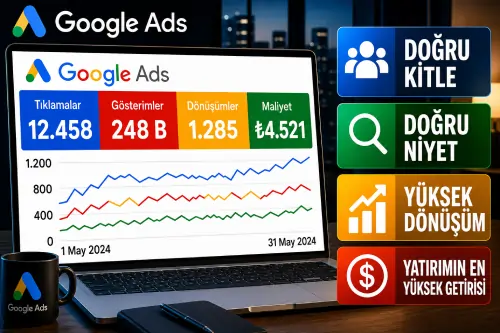
Google Ads stands at the center of the "pull" marketing strategy as it captures the moment users are actively seeking a solution to a problem. When a business owner or purchasing manager searches for "corporate cloud solutions" on Google, they declare their immediate need for that service. This intent-driven approach generally ensures that conversion rates in B2B advertising efforts are higher compared to other channels. A well-configured search campaign places your brand right in front of them at the point where demand is strongest.
The core logic of this strategy is not to chase demand, but to be positioned right in the middle of existing demand. Since the user is in search of a solution, the probability of them showing interest in your offer once they land on your website is quite high. Thanks to keyword match types and negative keyword lists, Google Ads allows you to spend your budget only on searches relevant to you. Campaigns conducted through high-volume and specific search terms are particularly unrivaled for reaching prospects at the bottom of the sales funnel.
The most distinct advantage of using Google Ads is its potential to capture hot leads and its operational speed. From the moment you launch your campaigns, you can start receiving inquiry forms from potential customers and accelerate the sales process. Furthermore, thanks to Google's advanced measurement tools, it is possible to track down to the cent which keyword converts directly into a sale. This transparency makes it easy to optimize the performance of the marketing budget in real-time.
Conversely, the disadvantages of Google Ads include high-competition keyword costs, especially in the B2B sector. As sectoral competition increases, costs per click (CPC) can reach significant levels, which can threaten profitability. If your keyword strategy is not specific enough, budget wastage due to individual users or irrelevant searches is inevitable. Therefore, to conduct successful B2B ad management on Google Ads, one must master technical details and continuous optimization.
LinkedIn Ads: Precision Targeting-Focused B2B Advertising Strategy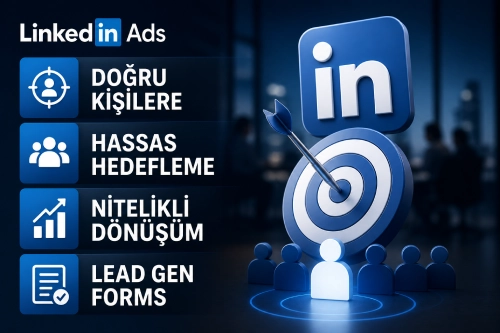
LinkedIn Ads operates on a "push" marketing logic and utilizes the unique demographic data offered by the professional network. Here, ads are shown based on users' titles, the companies they work for, their seniority levels, or the sectoral groups they belong to. This method is ideal when you know exactly who should see your solution, but those individuals are not actively performing a search at that moment. LinkedIn is an unparalleled medium for building brand authority and establishing a place in the minds of decision-makers.
Providing direct access to the right title, sector, and company scale on the LinkedIn platform reduces ad waste to almost zero. For example, you can design specialized campaigns only for Finance Directors (CFOs) in Turkey or for Logistics Companies above a certain employee count. This targeting precision guarantees that your message reaches the decision-making mechanism directly. Since you are within a professional ecosystem, the technical content and case studies you share find a much more serious response.
Among the advantages of using LinkedIn, pinpoint access and qualified brand awareness rank at the top. You can address hard-to-reach profiles such as CEOs, directors, and purchasing managers directly on their homepages (feed). This platform offers a trust-building environment, especially for high-ticket products and services. Thanks to Lead Gen Forms, it is also possible to collect qualified data directly within LinkedIn without directing users to your site.
However, the disadvantage of LinkedIn Ads is that it generally has higher CPC (Cost Per Click) rates compared to Google Ads. In professional segments where competition is intense, the cost of a click is significantly higher than other social platforms. Additionally, since users are not searching for a solution at that moment, the conversion time may be longer and the sales funnel may progress more slowly. This situation necessitates patience in budget management and a long-term relationship management strategy.
Meet LinkedIn campaigns that provide accurate targeting, strong content, and measurable conversion for B2B-oriented brands. Reach us now at 0850 333 80 91 or visit our LinkedIn Advertising page for detailed information.
LinkedIn Ads or Google Ads? A Comparative Analysis
When managing your digital marketing budget, the dilemma you most frequently encounter probably revolves around the question: "LinkedIn ads or Google Ads?" Although both platforms play critical roles in the B2B ecosystem, performance metrics differ dramatically according to your goals. While Google focuses on the "intent" of those seeking solutions, LinkedIn invests in "target audience accuracy" with its professional identity. Clarifying the mechanical differences between these two giants helps you increase your qualified lead volume while lowering your advertising costs.
|
Criterion |
Google Ads (Search Network) |
LinkedIn Ads |
|
Primary Focus |
User Intent (Active Search) |
Professional Identity (Title/Sector) |
|
Budget Flexibility |
Can be tested quickly with small budgets |
Generally requires a higher entry budget |
|
Conversion Speed |
Very High (Captures at the moment of need) |
Medium (Brand trust building process) |
|
Target Audience Quality |
Variable (Risk of irrelevant traffic) |
Very High (Pinpoint decision-makers) |
|
Cost (CPC) |
Varies according to competition |
Generally higher cost per click |
In terms of budget management, Google Ads allows you to experiment quickly with low-cost (long-tail) keywords. However, LinkedIn almost completely eliminates ad waste with filters such as "Company Size" or "Seniority Level." If your product's sales cycle is short, Google's speed comes to the fore; if your product is high-priced and the persuasion process is long, LinkedIn's prestige takes priority.
Record Conversion in B2B E-Export with Setre
On the e-export journey we embarked upon with Setre, we aimed to transform the brand's B2B potential in the global market into reality through the power of digital. In a short period of six months, we performed simultaneous performance management in nearly 20 countries covering Europe, the Middle East, and Turkic Republics. As Magna Dijital Marketing Agency, we designed a measurable demand collection model that contributes directly to export volume, not just visibility.
During the strategy phase, the issue we focused on most was selecting the right channel according to the digital habits of each market. At this point, we analyzed the question "LinkedIn ads or Google Ads?" with data on a per-country basis and designed a hybrid budget management. By combining the intent-oriented power of Google Ads with LinkedIn's title-based precise targeting, we carried our B2B advertising performance to the highest level.
The quality of the landing surface that would receive the ad traffic constituted one of the most critical pillars of this success. The 100% custom-designed and performance-oriented landing page structures we prepared for Setre not only attracted the user to the page but also guided them to fill out forms by instilling trust. With our data-driven optimization processes, we increased the probability of every click turning into a concrete commercial opportunity.
The concrete figures we reached through this structure we established as Magna Dijital Marketing Agency are as follows:
- Project Duration: 6 Months
- Scope: 15 - 20 Different Countries (Global)
- Total Generated Leads: ~1,000 Qualified B2B Inquiries
- Average Monthly Performance: 150+ B2B Form Conversions
- Conversion Infrastructure: 100% Custom Design and Performance-Oriented Landing Pages
These results show how digital advertisements transform into a measurable growth engine when the right strategy and technical infrastructure combine. The Setre case is strong evidence of how authority can be established on a global scale in a short time for B2B brands with an e-export focus. As Magna Dijital Marketing Agency, we continue to carry our brands to the top of the world market by combining the power of data with strategic creativity.
Which Channel is More Suitable for Your Sector?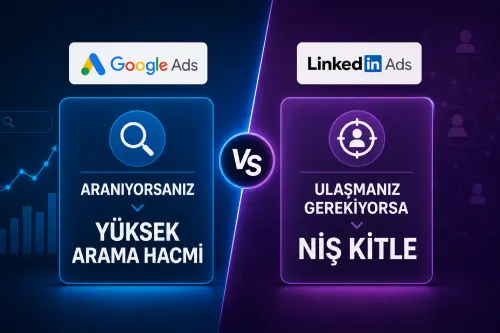
In the B2B world, the dynamics of every sector are different, and therefore applying a standard prescription does not always yield the best result. If you address a niche sector and your potential customers are a limited audience with specific titles, LinkedIn should undoubtedly be your primary channel. However, if your product addresses a general need and search volume is high, it is more logical to gain market share quickly via Google Ads. What matters is that the nature of the medium you advertise on matches the value offered by your service.
When creating your strategy, you should ask yourself: "Are my customers looking for me, or do I need to introduce myself to them?" If the former applies, Google should be your priority; if the latter applies, LinkedIn. However, it should not be forgotten that establishing authority in the digital world requires a holistic presence. A strategy fed by data-driven analyses and utilizing the strengths of both channels will always carry you one step ahead of the competition.
If you are not sure that your current advertising strategy will carry your brand into the AI age and toward your target growth figures, you may need a professional perspective. While questioning your own strategy, focus on what the data tells you and invest in business results, not just clicks. A well-constructed B2B advertising plan is the most powerful tool shaping your business's digital future. Setting out with a professional strategy to create the growth plan best suited to your sectoral dynamics will prevent loss of time and budget.
Take advantage of our professional consultancy service to manage budget, targeting, and performance management across all digital channels from a single center. Reach us now at 0850 333 80 91 or visit our Digital Advertising Consultancy page for detailed information.
Frequently Asked Questions
Which platform is more cost-effective in B2B advertising efforts?
Cost-effectiveness depends entirely on your target audience's digital behavior and your product's sales cycle. Google Ads allows you to get quick results from high-intent searches with small budgets, while LinkedIn ensures you reach only decision-makers despite higher click costs.
Which gives faster results: LinkedIn Ads or Google Ads?
Google Ads generally provides faster form and sales conversion as it responds to users' active current needs. LinkedIn, on the other hand, builds a professional trust relationship, so the conversion process is longer but more permanent in terms of brand authority. Google Ads is a priority for your short-term lead targets, while LinkedIn is a strategic priority for your medium and long-term market leadership goals.
What should be done to increase lead quality in B2B advertisements?
To collect qualified leads, not only the ad setup but also the landing page experience where the traffic arrives must be flawless. LinkedIn's title and company-based targeting power increases lead quality by allowing you to reach people who have direct purchasing authority. On the Google Ads side, filtering irrelevant traffic with negative keyword management and correct match types is critical.
Is it logical to use both platforms simultaneously (Hybrid Strategy)?
Absolutely yes; the most successful B2B results generally come from hybrid models where both platforms support each other. Following potential customers who found your brand via Google Ads with title-based remarketing ads on LinkedIn significantly increases conversion rates. This method builds trust by ensuring the decision-maker sees your brand in different professional contexts throughout their purchasing journey.
For which sectors is LinkedIn a priority, and for which is Google Ads?
LinkedIn is unrivaled if the service you offer is in a very niche area and addresses only managers with specific titles. However, in sectors with high search volumes, such as corporate software or logistics, collecting demand via Google Ads can be more efficient.
.webp)