


The fundamental reason your brand is invisible in AI search engines is that the system does not perceive you as a credible source. Unlike traditional search engines, systems like ChatGPT need to identify your brand as a semantic entity while crawling data across the web. If your digital assets do not carry a coherent structure that Large Language Model (LLM) and Knowledge Graph algorithms can understand, the likelihood of your brand being recommended in responses to user queries disappears entirely. This situation stems from a lack of Generative Engine Optimization (GEO) strategies.
Discover our GEO strategies to increase your brand's visibility in AI-powered search engines (ChatGPT, Gemini, Perplexity, etc.). You can reach us immediately at 0850 333 80 91 or visit our Generative Engine Optimization page.
What Is AI Brand Visibility and How Do LLMs Work?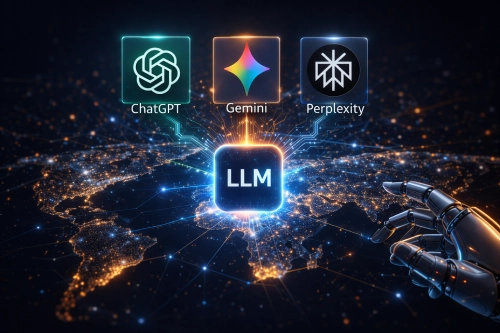
AI brand visibility is the recognition of a business by large language models such as ChatGPT, Gemini, and Perplexity, and its recommendation to users as a trustworthy source.
The Relationship Between Knowledge Graph and Brand Entity
A knowledge graph is a vast data network through which AI systems map objects, people, and brands in the world based on their semantic relationships with one another. Rather than reading words one by one in the background, this system works by analyzing the connections between concepts.
For a brand to be included in this graph, it is critically important that it has a consistent, verifiable structure within the digital ecosystem that is associated with other trusted entities. When search engines identify your brand as an independent entity, they match you with relevant industry queries.
For example, a B2B software company is not recommended by ChatGPT simply because it writes "best CRM" on its own website. However, if it is consistently mentioned in the context of "CRM solutions" on review platforms, industry news sites, and professional networks, AI marks that brand as a strong node in the knowledge graph.
When brands correctly build this semantic network, AI models directly recommend them as the most trustworthy and natural choice when answering complex user queries.
Training Datasets and Real-Time Search (RAG) Dynamics
Large language models are trained on billions of pages of text data across the internet, and this training process allows them to learn the digital footprints of brands. However, static training data can lose its currency over time.
RAG (Retrieval-Augmented Generation) technology, which comes into play at this point, enables AI models to generate responses by pulling real-time information from the internet in addition to their own training data. Tools like ChatGPT perform instant scanning through search engine infrastructures when they encounter a current query.
Platforms that present their data with clear headings and schema markup are noticed much more quickly by AI during these instant scans. It is not enough for content to simply exist; it also needs to be easily accessible and structured for AI bots.
The future of digital marketing is being shaped by artificial intelligence. Magna Dijital Marketing Agency accelerates brands' digital transformation with data-driven approaches and LLM (Large Language Model)-based strategies. Contact us to carry your brand into the future with GEO, machine learning, and AI-powered marketing applications. You can reach us immediately at 0850 333 80 91 or visit our Artificial Intelligence and Technology page for detailed information.
The Core Reasons ChatGPT Does Not Recommend Your Brand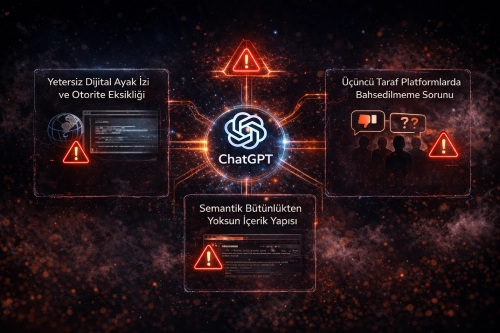
If your brand does not appear in responses when your target audience asks AI questions about your industry, it means there are structural gaps in your digital strategy. (What Is Generative AI? How Does Generative Artificial Intelligence Change Our Lives?)
Insufficient Digital Footprint and Lack of Authority
A digital footprint is the sum of all of a brand's assets, references, and informational traces across the internet. Before recommending a brand, AI models scan signals across the web to verify how trustworthy it is.
If your brand only has a presence on its own website and is not making an impression in the outside world, algorithms interpret this as a lack of authority. Content published solely on your own site is not sufficient for AI to accept you as an independent authority.
Building a comprehensive digital footprint ensures that your brand is registered by AI as an established player in your industry and is therefore recommended more frequently.
Content Structure Lacking Semantic Coherence
Semantic coherence means that content is not merely stuffed with certain keywords, but that the topic is explored in depth together with all its subtopics and related concepts. Large language models analyze texts contextually.
If a piece of content is superficial, scattered, or written solely to manipulate search engine bots, AI finds that text worthless. Content must be machine-parsable and have a logical hierarchy.
When a company selling "cloud computing" services fails to structure related concepts such as "data security," "server costs," and "scalability" with clear headings in its content, AI does not find that content sufficient to answer a user's complex question.
Brands that produce semantically rich and structured content gain the advantage of being selected as the primary source during AI's knowledge synthesis process.
The Problem of Not Being Mentioned on Third-Party Platforms
Third-party platform mentions (brand mentions) refer to your brand being discussed organically on independent review sites, forums, and social networks outside your control. ChatGPT, in accordance with its impartiality principle, does not rely solely on a brand's own statements.
For example, a software startup may claim to offer "the fastest integration" on its own site, but if independent platform users are not posting reviews confirming this speed, ChatGPT will not reference this claim when recommending it to other users.
Increasing positive brand references on independent platforms maximizes AI's trust in your brand and directly boosts your visibility.
Make your business processes smarter, more efficient, and more predictable with AI-powered marketing models. For details, you can reach us immediately at 0850 333 80 91 or visit our Artificial Intelligence Consultancy page.
Solution Steps for Becoming Visible in AI Searches
To have your brand recognized and recommended by ChatGPT and other AI assistants, you should quickly implement the following strategic steps:
- Multiply Brand Mentions: Focus not only on acquiring backlinks, but on getting your brand mentioned on trusted news sites, industry blogs, and review platforms.
- Produce User-Focused and Clear Content: Create FAQ sections that directly answer the questions your target audience asks, and transparently explain pricing and processes.
- Use Structured Data (Schema Markup): Technically mark up your content so that search engine bots and AI crawlers can better understand your site.
- Optimize Your Google Business Profile: ChatGPT relies heavily on map and business data when making local recommendations. Make sure your profile is complete and up to date.
- Build a Consistent Digital Identity: Ensure that your brand message is completely identical across your website, social media accounts, and third-party directories.
- Allow AI Bots: Make sure your site's robots.txt file does not block crawlers such as GPTBot and Bingbot from accessing your content.
Differences Between Traditional SEO Visibility and AI Visibility
The key differences between not being visible on Google and not being visible on ChatGPT clearly reveal which gaps in your digital strategy need to be addressed.
|
Comparison Criterion |
Traditional SEO Visibility (Google) |
AI Visibility (ChatGPT/LLM) |
|
Primary Focus |
Keyword optimization and backlink profile. |
Semantic context, knowledge graph, and brand mentions. |
|
Content Structure |
Long and detailed pages that satisfy search intent. |
Machine-readable, structured, and clear answers. |
|
Authority Signal |
Domain Authority (DA) and external link quality. |
Mentions on third-party platforms (Trustpilot, Reddit, etc.). |
|
Technical Access |
Correct indexing, site speed, and mobile compatibility. |
Allowing AI bots (GPTBot) to crawl the site. |
|
User Interaction |
Click-through rate (CTR) and time spent on page. |
Providing direct, synthesizable, and citable answers to queries. |
Transform your business results by using artificial intelligence and machine learning in data analytics, customer behavior prediction, and performance optimization processes. For detailed information, you can reach us immediately at 0850 333 80 91 or visit our Artificial Intelligence and Machine Learning page.
Frequently Asked Questions
Why does ChatGPT never recommend my brand?
The main reason ChatGPT does not recommend your brand is that your digital footprint is insufficient and the AI model does not perceive you as a trustworthy semantic entity. The absence of your name on third-party platforms and your content not being in a machine-readable format trigger this situation.
Are backlinks enough to become visible in AI searches?
No, backlinks alone are not sufficient. AI models place greater importance on your brand being organically mentioned (brand mentions) on various platforms (news sites, forums, review platforms) and on its contextual authority, rather than on clickable links.
How can I tell if my site is being crawled by ChatGPT?
You can check your server logs to see whether GPTBot or Bingbot has visited your site. Additionally, you should make sure that your robots.txt file grants access to these bots.
How long does it take for GEO (Generative Engine Optimization) work to produce results?
It takes time for AI models to crawl new data, learn from it, and incorporate your brand into the knowledge graph. A regular and strategic GEO effort generally begins to produce positive effects on visibility within 3 to 6 months.
How should I structure my content to appear in ChatGPT?
You should organize your content hierarchically with clear headings, add FAQ sections that directly answer questions, and use structured data (schema markup) to convert your information into a format that AI can easily synthesize.
Should I abandon traditional SEO and shift entirely to GEO?
Absolutely not. Traditional SEO and GEO are mutually reinforcing strategies. Sites that hold high authority in search engines like Google and have a solid technical SEO foundation are also considered more trustworthy by AI models and are referenced more frequently.
How does RAG (Retrieval-Augmented Generation) technology shape brand visibility?
RAG technology enables AI to perform real-time web crawling and deliver the most current information. This makes it essential for brand visibility that you keep your content continuously updated and provide a technically fast-crawlable infrastructure.


.webp)